Want to learn how to build a cheap house? Look no further. Let me ask you; how would your life change if you never had to pay rent or interest on a mortgage again? I bet it would take a significant weight off your shoulders. It sure would for me.
You’re not alone, in fact today most people in “civilized” parts of the world don’t own their homes but are indebted to banks or rent from a landlord. But it has not always been this way, as Henry David Thoreau so truthfully writes in his book Walden:
In the savage (Native American) state every family owns a shelter as good as the best, and sufficient for its coarser and simpler wants; but I think that I speak within bounds when I say that, though the birds of the air have their nests, and the foxes their holes, and the savages their wigwams, in modern civilized society not more than half the families own a shelter. In the large towns and cities, where civilization especially prevails, the number of those who own a shelter is a very small fraction of the whole. The rest pay an annual tax or this outside garnment of all, become indispensible summer and winter, which would buy a village of Indian wigwams, but now helps to keep them poor as long as they live.
Is this the best humanity can do?
Is it impossible to imagine a future where humans, just as other animals, own their shelter free and clear and don’t have to pay a “tax” their whole lives just to stay protected from the elements?
Of course not. This is crazy!
In the list below you’ll find examples of homes that “savage” people throughout the world built with their own hands using locally available materials that Nature provided for free. No mortgage or rent required.
Most of the examples on this list are small house designs. They are small because a small house takes less fuel to heat, less time and building materials to build, and for some of the more portable designs a small home is much easier to move.
What you take away from this list is up to you, but I have no doubt there’s a lot to learn from how our ancestors lived in harmony with their surroundings and adapted perfectly to their environments, no matter how harsh.
15The Walipini
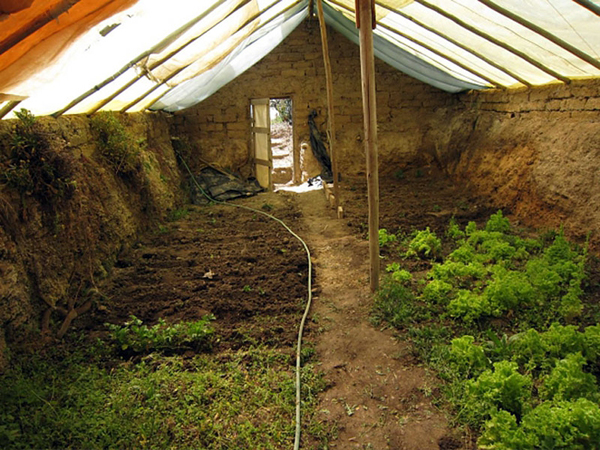
Not as ancient as the other shelters on this list, the walipini is still worth a mention because it’s such a simple yet brilliant idea, and it can be built for as little as $300.
A walipini is an underground greenhouse that lets you grow food year-round, and the idea was first developed in Bolivia, South America. It uses the same earth sheltering principles as many of the ancient house designs on this list.
What makes the walipini better than hoop houses and green houses? First, by locating the growing area 6’- 8’ underground you take advantage of the constant temperature of the earth below the frost level. Second, you can capture and store the daytime solar radiation in the surrounding earth which then radiates back into the greenhouse during the cold winter nights.
What Can We Learn?
You might not want to move into a tipi any time soon, but there are still a lot to learn from our ancestors.
These ancient house designs are better than modern homes in many aspects because they were adapted specifically for their environments. The homes in the Arizona desert looked much different from the homes in the Alaskan tundra, and nomadic people had different needs than agricultural people.
The point is that our ancestors were as One with their environments and co-existed with Nature. These people were native to the land, while modern man is more like an invasive species that does not know its place in Nature.
But, maybe most of all, these homes illustrate that the builders knew when enough was enough. They were clear about the purpose of building a home, i.e. to stay protected from the elements and have a safe place to sleep, rather than constantly expending their life energy on trying to build bigger and fancier homes.
Here’s a closing thought from Henry David Thoreau:
It is possible to invent a house still more convenient and luxurious than we have, which yet all would admit that man could not afford to pay for. Shall we always study to obtain more of these things, and not sometimes to be content with less? Shall the respectable citizen thus gravely teach, by precept and example, the necessity of the young man’s providing a certain number of superfluous glow-shoes, umbrellas, and empty guest champers for empty guests, before he dies? Why should not our furniture be as simple as the Arab’s or the Indian’s?
Why indeed?
If you liked this Walden Labs-exclusive post then sign up below for more like it, and together we’ll explore how to improve life on Planet Earth (and beyond) through experiments in self-reliance and decentralization.